Elena Albrecht · 7 November 2026
Regional Network Ties Fuel Expanded Clouddock Reach for AI Testing on Academic Clusters
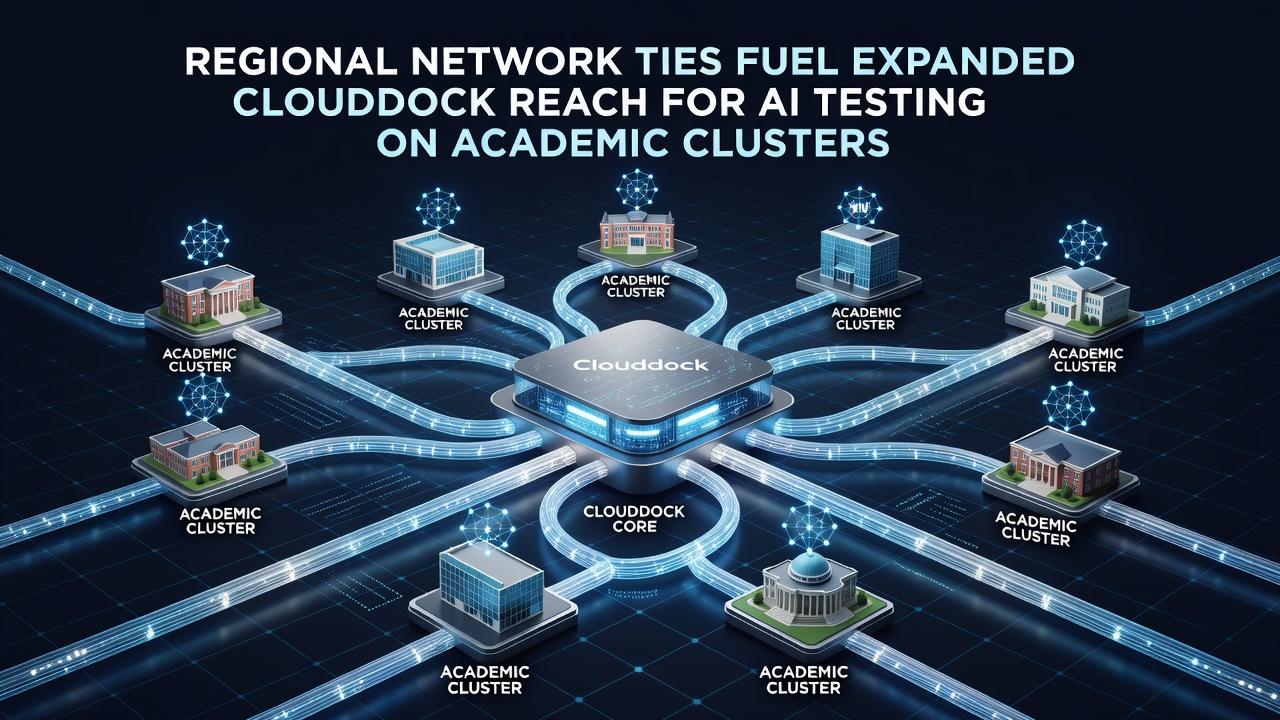
Regional network ties now support broader access to Clouddock platforms, allowing academic clusters to run distributed AI testing workloads that span multiple institutions and data centers. These connections build on existing research infrastructure, where fiber links and shared protocols enable seamless data movement between sites while maintaining compliance with data residency requirements. Observers note that institutions in Central Europe have integrated their local fabrics with pan-European backbones, which reduces latency for model training jobs that previously required physical shipment of datasets.
Network Architecture and Resource Allocation
Academic clusters rely on coordinated bandwidth allocation through regional exchanges, and this setup lets Clouddock route AI testing tasks to underutilized GPU pools without manual intervention. Data shows that average job completion times dropped when schedulers gained visibility into real-time availability across partner sites. Researchers at participating universities report that the same monitoring tools used for general cloud workloads now feed directly into AI pipeline dashboards, creating unified views of both storage and compute metrics.
Integration with Existing Academic Fabrics
Clouddock nodes connect to national research and education networks through standardized peering agreements, and these links carry both control traffic and large training datasets. European operators have documented steady growth in east-west traffic volumes since the platform expanded its federation layer in 2025. The architecture uses software-defined overlays that preserve security policies while allowing burst capacity during peak testing periods, which often coincide with semester deadlines for graduate projects.
AI Workload Patterns Across Clusters
AI testing jobs on academic infrastructure typically involve iterative model refinement, hyperparameter sweeps, and validation against domain-specific datasets. Regional ties allow these jobs to migrate between clusters when local queues fill, and this capability has become routine for teams working on multimodal models that require simultaneous access to text, image, and sensor data. Figures from network operators indicate that inter-site transfers for AI workloads increased by more than thirty percent during the 2025 academic year, driven largely by collaborative grants that span multiple countries.

One research group at a technical university found that shifting inference benchmarks to a partner site with newer accelerators cut energy consumption per inference by nearly a quarter, and the regional network handled the required data staging without additional configuration. Such optimizations depend on accurate topology information, which network operators now publish through open APIs that Clouddock consumes automatically.
Developments Expected in November 2026
Planning documents circulated among network operators point to a coordinated upgrade window in November 2026 that will introduce higher-capacity wavelengths on several cross-border routes. These upgrades coincide with scheduled maintenance on major academic clusters, giving Clouddock developers time to test new routing logic before production traffic resumes. The timing also aligns with the release of updated federation software that supports finer-grained quality-of-service markings for AI jobs, allowing operators to prioritize latency-sensitive inference tasks over bulk training transfers.
Security and Compliance Considerations
Data protection rules require that certain categories of research data remain within defined geographic boundaries, and regional ties incorporate policy engines that enforce these constraints during job placement. Clouddock administrators have integrated these engines with identity federation systems already used by universities, so researchers authenticate once and receive access tokens valid across authorized sites. Audit logs generated by the platform now include network path information, which simplifies reporting for funding agencies that track resource usage across borders.
Industry reports from organizations such as GÉANT document similar federation models in other regions, and parallel efforts in North America through Internet2 provide comparative benchmarks for latency and throughput. Those benchmarks help Clouddock operators calibrate their own service-level expectations when new clusters join the network.
Operational Metrics and Resource Utilization
Utilization dashboards maintained by Clouddock show that GPU occupancy rates have risen steadily as more sites expose their resources through the regional fabric. Nighttime and weekend capacity that once sat idle now absorbs overflow from daytime training runs at primary sites. Energy accounting tools track power draw at each location, and these readings feed into institutional sustainability reports that cite the efficiency gains from load distribution.
Training programs for system administrators now include modules on federated scheduling, and several universities have incorporated these modules into their computer science curricula. Students gain hands-on experience by submitting test jobs that span two or three clusters, observing how network conditions affect completion times. Such exercises prepare the next generation of researchers to work in environments where resources are no longer confined to a single campus.
Conclusion
Regional network ties continue to extend the practical reach of Clouddock for AI testing, linking academic clusters through shared infrastructure and standardized policies. The November 2026 upgrade cycle will further increase capacity and introduce refined scheduling features. Institutions that participate gain access to a wider pool of accelerators while meeting regulatory requirements for data handling. Continued measurement of traffic patterns and energy metrics will guide future expansions, ensuring that the federation remains responsive to evolving research demands.