Elena Albrecht · 10 October 2026
Regional Research Networks Enhance AI Performance Across Academic Cloud Environments
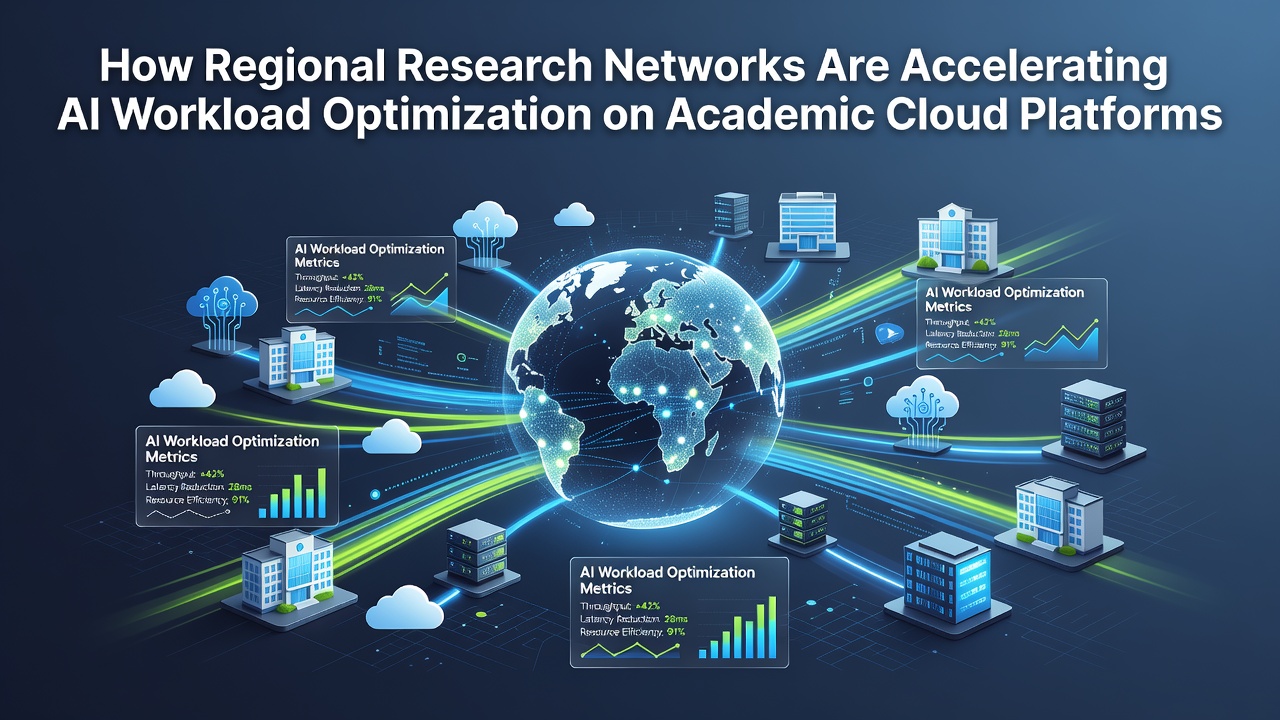
Regional research networks connect universities and research institutions through high-capacity fiber links and shared compute resources, allowing AI workloads to run more efficiently on academic cloud platforms. These networks reduce data transfer bottlenecks while enabling dynamic resource allocation across multiple sites, and institutions in North America, Europe, and Asia-Pacific have reported measurable gains in training throughput since 2024.
Academic cloud platforms typically combine on-premises GPU clusters with federated storage systems, yet many face challenges in scheduling large-scale model training jobs that span several campuses. Regional networks address this by providing dedicated bandwidth and latency-aware routing that keeps datasets close to compute nodes, which cuts job completion times without requiring additional hardware purchases at individual universities.
Network Architecture Supporting Distributed AI Tasks
Modern regional networks deploy software-defined overlays that prioritize traffic from AI frameworks such as PyTorch and TensorFlow, routing packets over the shortest available paths while monitoring congestion in real time. Observers note that this approach allows a single training run to pull training data from storage in one city and process it on accelerators located hundreds of kilometers away, maintaining consistent performance levels.
In October 2026 several European regional networks completed upgrades that added 400 Gbps links between major academic clouds, expanding capacity for multi-node inference workloads. Data from these deployments show average reductions in communication overhead of 35 percent compared with earlier configurations that relied on commodity internet paths.
Resource Scheduling and Optimization Techniques
Researchers at institutions connected through these networks have implemented joint scheduling systems that match AI job requirements to available GPU memory, interconnect speed, and storage locality. The systems use predictive models trained on historical usage patterns to forecast demand, then migrate virtual machines or containers ahead of peak periods, which prevents queue backlogs that once stretched into days.
One documented case involved a consortium spanning three countries where the regional network coordinated checkpoint transfers during long-running language model training, allowing the job to resume on a different cluster after a hardware fault without restarting from scratch. Figures from the project indicate an overall 22 percent improvement in effective utilization of expensive accelerator hours.

Energy Efficiency and Cost Considerations
Academic operators track power consumption closely because AI training can dominate campus electricity budgets. Regional networks enable load shifting to sites where renewable energy availability is higher at a given hour, and they support container migration that keeps total energy use lower while preserving job deadlines. Studies conducted across North American research networks report corresponding drops in carbon intensity per trained model without extending wall-clock time.
Cost models have also shifted because shared network resources reduce the need for every institution to maintain peak-capacity links year-round. Instead, capacity scales through peering agreements, and billing reflects actual transferred volume rather than reserved bandwidth, which aligns expenses more closely with research output.
Security and Compliance Frameworks
Data protection requirements vary by jurisdiction, yet regional networks incorporate encryption at the optical layer and policy engines that enforce access rules before jobs access remote datasets. These controls allow compliance teams to audit cross-border flows while researchers continue to collaborate on large models. Government agencies in multiple regions have published guidelines that reference these network-level safeguards as acceptable for sensitive but non-classified research data.
According to reports from the National Science Foundation, institutions participating in funded network projects recorded fewer policy violations related to data residency after adopting the new routing and logging features. Similar patterns appear in documentation released by Australia's Academic and Research Network, which highlights streamlined approval processes for multi-institution AI experiments.
Future Directions and Ongoing Deployments
Work continues on integrating quantum-safe encryption protocols and intent-based orchestration layers that let researchers describe desired outcomes rather than low-level network parameters. Pilot programs scheduled through 2027 aim to test automated placement of inference endpoints at the network edge, which would further lower response times for interactive AI applications used in teaching laboratories.
Those who manage these platforms emphasize that continued progress depends on sustained coordination among network operators, cloud providers, and domain scientists who generate the workloads. The infrastructure already in place demonstrates that regional connectivity can materially accelerate AI research when scheduling, security, and energy factors receive equal attention.
Conclusion
Regional research networks supply the connectivity layer that turns isolated academic clouds into coordinated platforms capable of handling demanding AI workloads. Measured improvements in throughput, energy use, and compliance demonstrate tangible outcomes from these investments, and ongoing upgrades scheduled into late 2026 indicate further refinements ahead.